
For several weeks now, I have been reading news reports, opinion pieces and debates about this summer’s wildfires. As an ecologist, I find it particularly interesting to observe how different groups analyse the same problem from very different perspectives.
There is one aspect, however, that has struck me particularly forcefully: when the forestry model is discussed, references are frequently made to the profitability of plantations, the value of timber or the economic losses that wildfires inflict on private property. All of these considerations are, of course, part of the problem and deserve to be taken into account.
What surprises me is how little attention the other half of the equation usually receives.
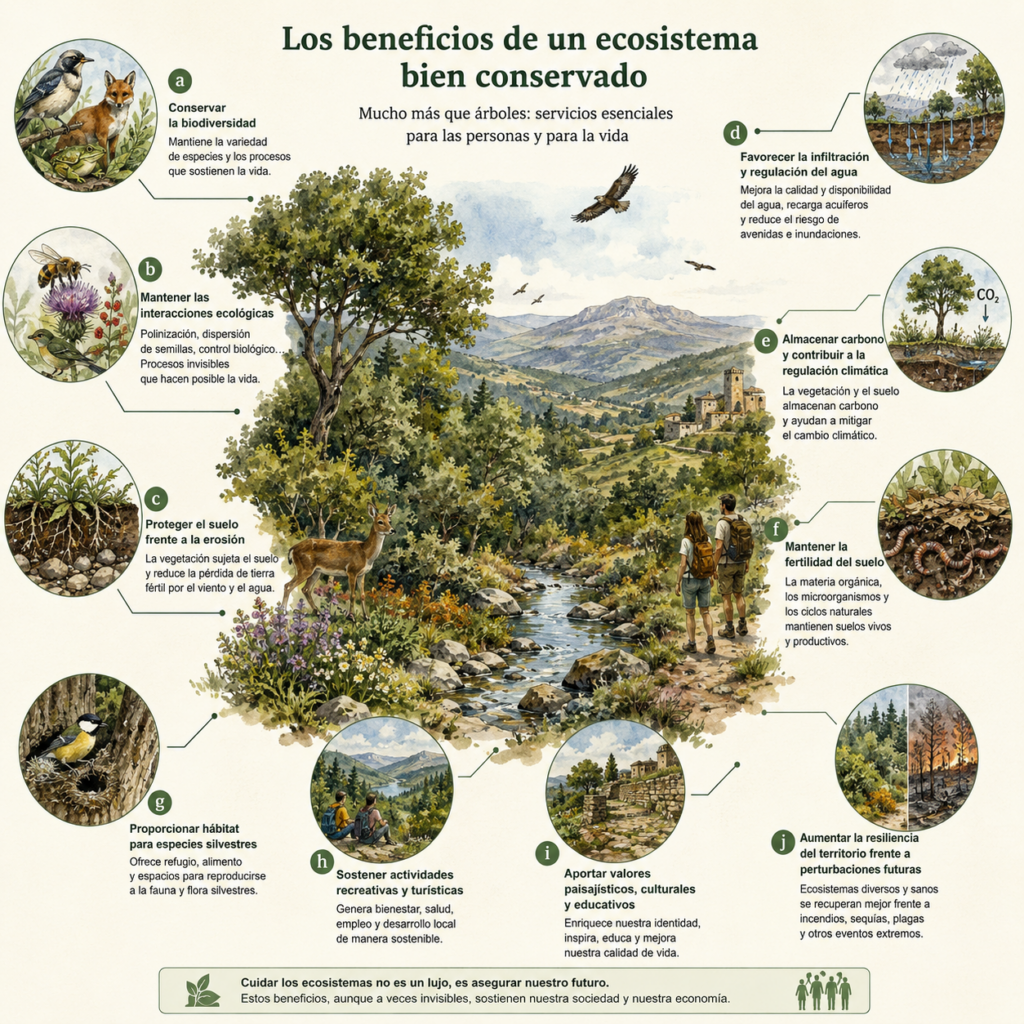
Natural ecosystems, including those areas of shrubland so often described as “unproductive”, generate an enormous range of benefits for society. Many of them are never traded in a market, but that does not mean they lack economic value. Among many other things, a well-preserved ecosystem helps to: a) conserve biodiversity; b) maintain ecological interactions such as pollination, seed dispersal and biological control; c) protect soil from erosion; d) promote water infiltration and regulation; e) store carbon and contribute to climate regulation; f) maintain soil fertility; g) provide habitat for wildlife; h) support recreational and tourism activities; i) provide landscape, cultural and educational values; and j) increase the resilience of the land to future disturbances. We need to understand that all these benefits have value for society, even if they do not appear on an invoice for the sale of timber.
Similarly, when a wildfire affects large areas of highly flammable plantations, we rarely discuss all the costs that ultimately have to be borne by the public. These may include, for example: a) the enormous cost of firefighting; b) the loss of fertile soil through erosion; c) air pollution caused by emissions; d) greenhouse gas emissions; e) damage to biodiversity; f) the degradation of ecosystem services; g) damage to homes and infrastructure; h) the effects of smoke on human health; i) the loss of landscape and tourism appeal; and j) a decline in future economic opportunities associated with a degraded landscape.
I am not suggesting that all these costs should be borne by forest owners. It would be incorrect to say—or propose—that they should. Many owners also suffer substantial economic losses when their land burns.
What I do wonder is whether a very large proportion of these costs is ultimately borne by society as a whole and, consequently, whether our accounting is sufficiently comprehensive when we debate which forestry model is genuinely most beneficial to society.
Perhaps the problem is not so much that plantations generate benefits—they obviously do—but that we tend to compare those private benefits with only a very limited proportion of the real costs, leaving out a wide range of public benefits and collective costs that are much more difficult to quantify.
I am not an environmental economist, which is why I prefer to frame this reflection as an open question rather than as a conclusion. Spain has outstanding researchers specialising in environmental economics and the valuation of ecosystem services who could undoubtedly contribute far more knowledge to this discussion.
Nevertheless, this perspective may be worth bringing into the debate.
Because, ultimately, when we talk about wildfires, we are not only deciding what kind of landscape we want to conserve. We are also deciding which costs and benefits we choose to include in our calculations—and for whom those calculations are actually being made.
Economics, like statistics, rarely deceives us; sometimes we are the ones who distort it by deciding which variables to include and which to ignore. That is why this post is dedicated, with all due respect, to those who continue to produce economic balance sheets in which ecosystem services are assigned a value of zero and many externalities simply do not appear.

