
A few days ago I experienced one of those small scientific joys with the flavour of time travel. We have just published a paper on biological invasions carried out in the Galápagos Islands, but the story behind the article began far earlier than its publication date might suggest. The fieldwork itself was conducted back in 2005… I still remember those observations with a little one barely a year old riding on my back on Isabela Island, walking among volcanic trails and populations of Kalanchoe pinnata, an exotic plant introduced to the islands. The manuscript was submitted to a journal in 2006 and, to our surprise, received an excellent response: acceptance with minor revisions in a Q1 journal. It seemed as though the story was nearing its end.
But it was not…
Academic life has something rather curious about it: urgency often pushes aside what truly matters. At that time both authors were immersed in multiple responsibilities and, above all, supervising doctoral theses and projects that we considered priorities. There were students waiting for results, papers that needed to move forward, and many competing demands on our time. And then something happened that many researchers will probably recognise: the manuscript remained on the desk… waiting for a better moment.
And that moment took almost twenty years to arrive… (I have never exactly been known for making quick decisions 😊).
Perhaps one of the small privileges of moving into later stages of professional life is learning to let go of certain responsibilities. In my case, by reducing some of the burden of administrative duties and other commitments, I have been able to look back and reconnect with work that had been suspended in a sort of academic limbo. And I discovered something rather curious: some data age far better than we do!
The study explored an interesting question: why do some exotic plants become invasive while others do not?
One of the best-known explanations is the so-called enemy release hypothesis. The idea is simple: when a plant arrives in a new territory, it leaves behind some of the herbivores, pathogens and natural enemies that kept it “under control” in its native range. Escaping from them may allow it to grow and spread more easily.
Nature, however, is rarely that simple.
There is another complementary idea known as the biotic resistance hypothesis, which proposes something almost opposite: ecosystems with diverse and complex native communities may act as a kind of natural barrier against invaders. The greater the biodiversity, the more difficult it may be for invaders to find ecological “empty spaces” to occupy.
And that is precisely what we observed in Galápagos.
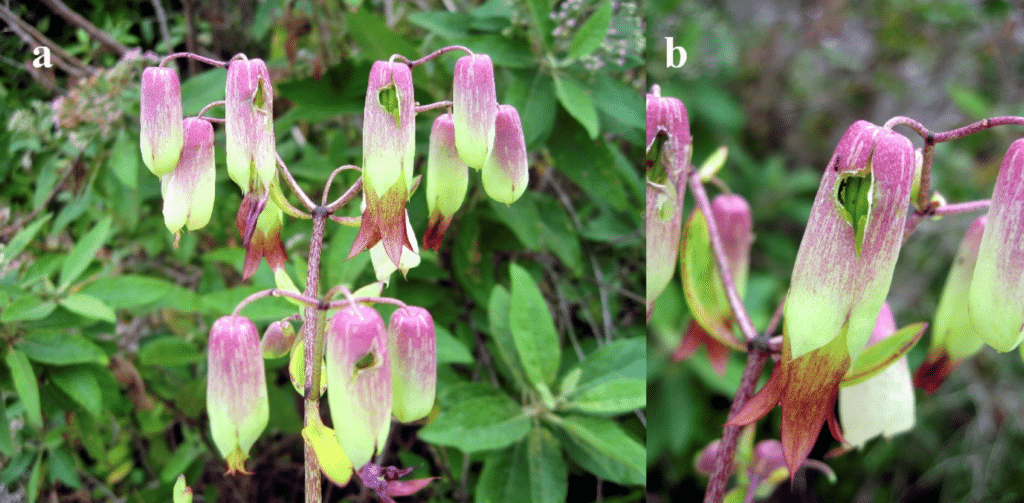
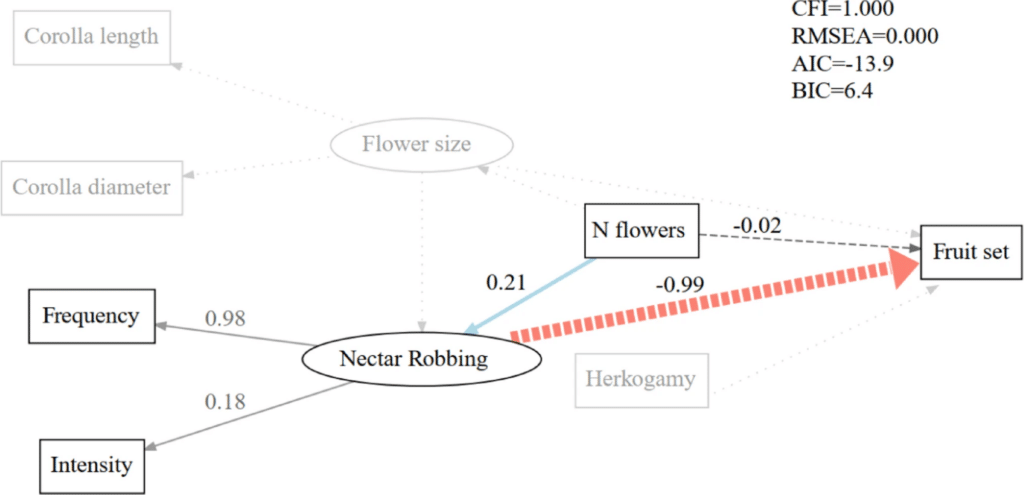
Two native species — a carpenter bee and a finch (yes, one of those famous finches that would later become emblematic symbols associated with Darwin’s evolutionary ideas) — systematically robbed nectar from Kalanchoe pinnata, piercing the flowers and greatly reducing fruit production. Interestingly, these native visitors appeared to act as an unexpected form of biological resistance against an introduced plant.
We often think about conservation solely in terms of rare or charismatic species, large animals, attractive organisms or spectacular landscapes. But perhaps the lesson is a different one: biodiversity itself also protects biodiversity. Those native species — sometimes inconspicuous, abundant or apparently less striking than many ornamental exotic plants — form part of ecological networks built over thousands or even millions of years. And it is precisely these networks that can sometimes make ecosystems more resistant and resilient.
Perhaps that is why it is worth remembering that what is most eye-catching is not always what is most valuable. Sometimes the best defence against future ecological problems is simply conserving what was already there.

