
Some scientific papers are remembered because of their findings. Others because of the place where the work was carried out. And a few—perhaps the most special ones—because of the people with whom the experience was shared. This small paper belongs to the latter category.
After more than twenty years of sharing field trips, conversations about nature, research projects, ideas, and countless hours among plants, animals, and field notebooks, we have just published our first scientific article as a true “family of biologists.” Although it may appear to be a brief note describing a single observation, for us it carries a meaning that extends far beyond a few printed pages.
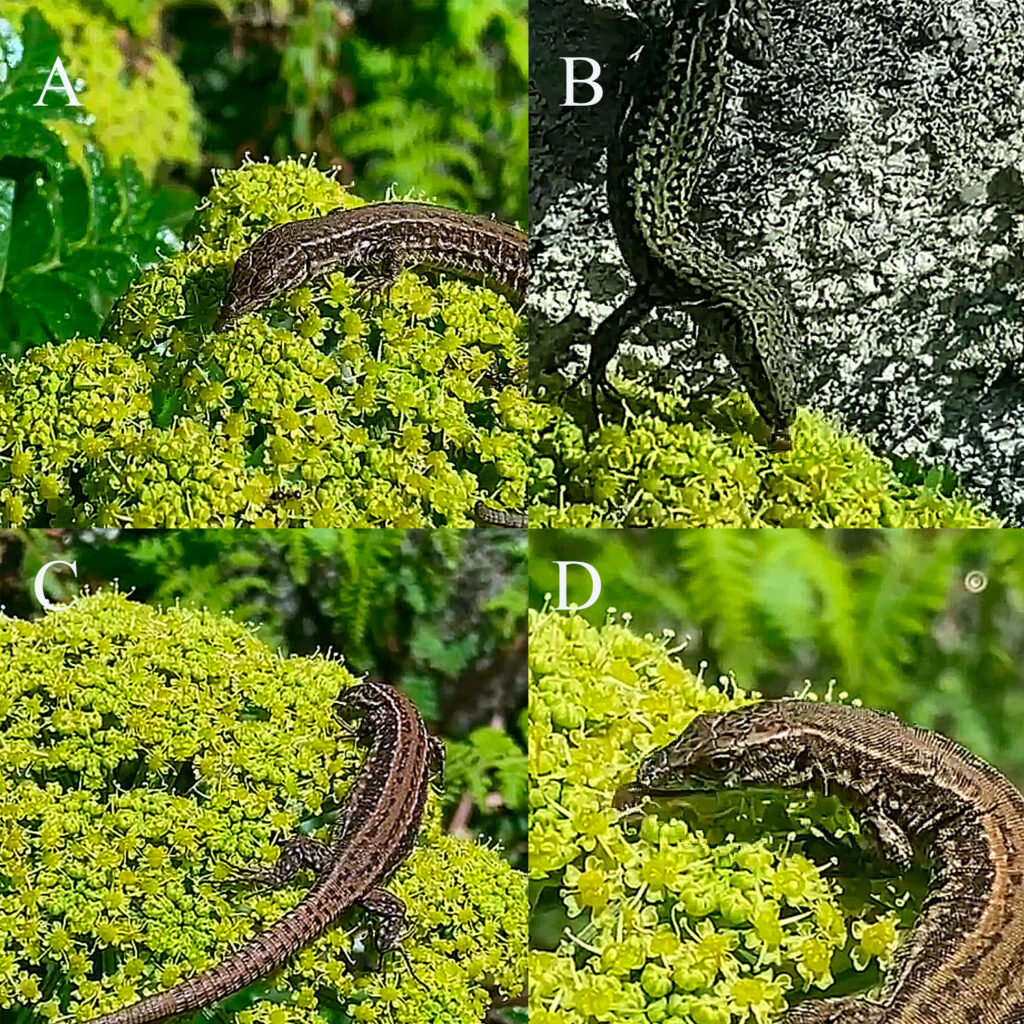
The story began during our work on pollination networks in the Atlantic Islands Maritime-Terrestrial National Park of Galicia, as part of a research project funded by Spain’s National Parks Agency. While studying interactions between flowers and their visitors on the Cíes Islands, we witnessed an unexpected scene: several individuals of Podarcis lusitanicus repeatedly visited the inflorescences of Angelica pachycarpa, inserting their heads among the flowers and licking nectar.
Lizards and flowers do not usually appear together in our mental image of pollination. Traditionally, we associate this process with bees, butterflies, hoverflies, or birds. Island ecosystems, however, often break what seem to be established ecological rules. Islands act as natural laboratories where lower species diversity, the relaxation of certain ecological interactions, and fluctuating resource availability can promote unexpected behaviours and expansions of ecological niches.That appears to be what happened here.
Our study provides the first evidence of nectar feeding and external pollen transport in Podarcis lusitanicus. Although it does not yet demonstrate effective pollination, it broadens our understanding of the diversity of interactions that can occur between vertebrates and plants in island ecosystems.
What makes this observation particularly interesting is not only the interaction itself, but also what it represents. For decades, much of pollination research has focused on the most familiar pollinators. Yet observations such as this remind us of something important: nature continues to harbour unexpected interactions, even in places that we believe to be well known.
The Atlantic Islands of Galicia continue to reveal themselves as an extraordinary natural laboratory for understanding how ecological networks function and how species respond to unique environmental conditions. And perhaps one of the most rewarding lessons is precisely this: when we observe patiently and with genuine curiosity, even a small lizard feeding among flowers can end up telling a much larger story—one that, I should add, is already beginning to unfold.
And yes, this time it was also a story written as a family.

