
We live in an era in which science is increasingly associated with large databases, complex models, high-throughput sequencing, and sophisticated statistical analyses. Yet, more often than not, knowledge begins in a much simpler way: with an unexpected observation made in the field.
We have just published a short scientific note that originated precisely in this way. It did not emerge from a funded research project or from a sampling campaign specifically designed to test a particular hypothesis. Instead, it arose during one of the natural history trips that a group of colleagues and I have been making for years under the simple excuse of continuing to learn from the natural world. These are journeys during which we spend a great deal of time walking, even more time observing, and maintain a habit that should never be lost in ecology: paying close attention.
The observation described in this note may seem modest. It does not aim to solve a major ecological question or provide definitive answers. Nevertheless, it documents a biological interaction observed in a geographical region that remains relatively unexplored from an ecological perspective. And that, in itself, is part of what makes it interesting.
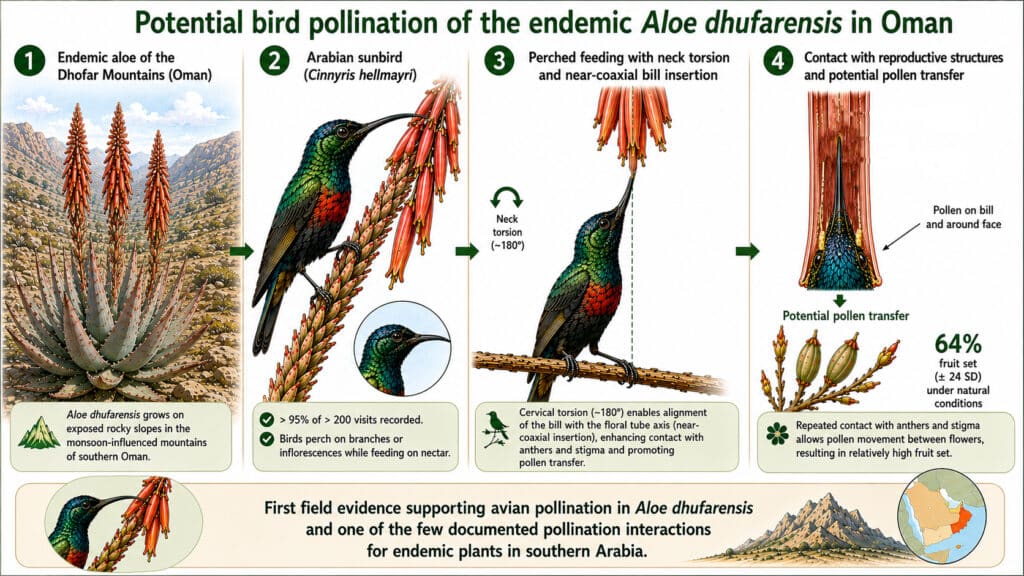
The observation that motivated this publication took place in the Dhofar Mountains of southern Oman, a remarkable region of the Arabian Peninsula influenced by monsoon winds and characterized by a high number of endemic species. There, we recorded more than 200 visits by the Arabian Sunbird (Cinnyris hellmayri) to the flowers of Aloe dhufarensis, an aloe species restricted to the mountains of southern Oman and southeastern Yemen. While feeding, the birds perched directly on the inflorescences or leaves and inserted their bills deep into the tubular flowers to access nectar. On numerous occasions, we observed their bills and facial feathers contacting anthers and stigmas, thereby transporting pollen between flowers. One particularly striking aspect of their foraging behaviour was their ability to twist their necks and align their bills with the floral axis, allowing an almost perfectly coaxial insertion into the corolla. This behaviour may have important implications for the effectiveness of the interaction from the plant’s perspective. Our observations suggest that Cinnyris hellmayri may play an important role as a pollinator of this endemic species and represent one of the few documented pollination interactions involving native plants from southern Arabia.
The major questions in ecology do not always emerge from major projects. Sometimes they begin simply by watching closely as a small bird inserts its bill into a flower on a remote mountain in southern Arabia.
The history of science is full of examples in which an apparently anecdotal observation ultimately opened entirely new lines of research. Before hypotheses can be formulated, phenomena must first be discovered. Before experiments can be designed, we need to know what is worth studying. For that, naturalists, field observations, and scientific curiosity remain indispensable. In this case, that has been our contribution.
Scientific journals often show a clear preference for studies based on large sample sizes or complex analyses (or, more recently, extremely long lists of authors—but that is a topic for another day). Yet there is also tremendous value in carefully documenting rigorous observations made in poorly studied regions. Such contributions expand our understanding of species distributions, ecological interactions, and the diversity of strategies found in nature. Moreover, many of these observations later become part of broader systematic reviews and meta-analyses, acquiring a relevance that extends far beyond the original scope of the observation.
In a sense, these short notes function as small windows into ecosystems that we still know only incompletely. Each contributes a fragment of information that may prove useful to future researchers. But they also serve another equally important purpose: they generate questions.
To what extent does Aloe dhufarensis depend on birds for reproduction? Do other floral visitors also contribute to pollen transfer? Is this interaction widespread throughout the Dhofar Mountains, or is it a local phenomenon? Are there other endemic Arabian plant species whose pollination ecology remains virtually unknown?
Answering these questions will require more detailed studies, but the questions themselves arise precisely from observations such as the one we have just published.
That is why we continue to believe in the value of going into the field with open eyes. There are still many stories waiting to be discovered. And sometimes, a simple observation made during a trip among friends can become a small contribution to scientific knowledge.
Nature continues to surprise us. Our responsibility, as scientists and naturalists, is to keep paying attention.

