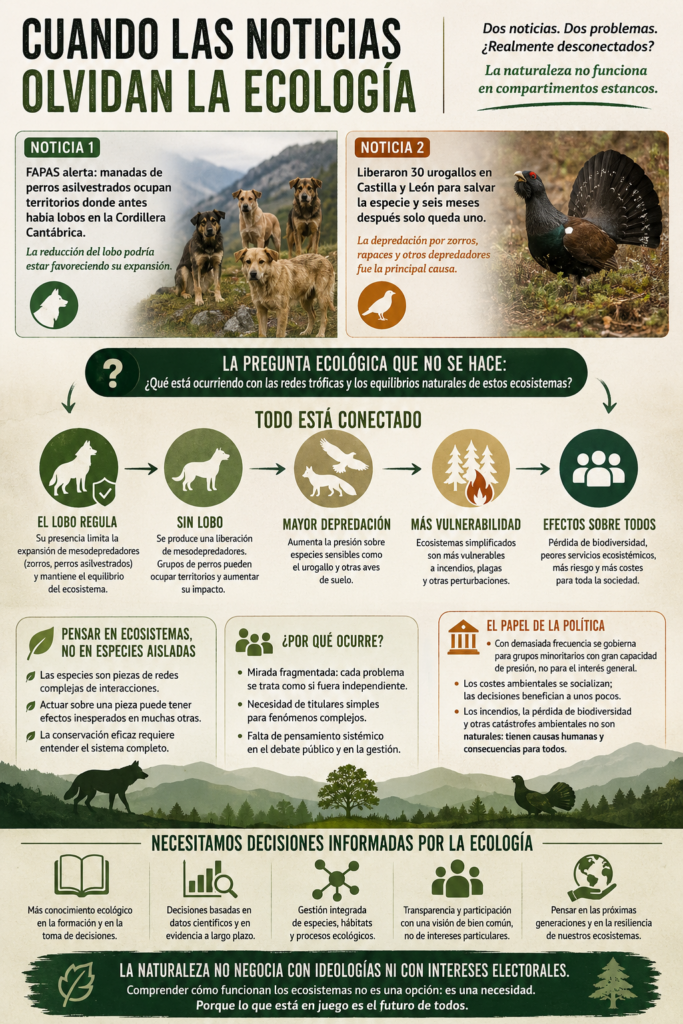
A few days ago, I read two news stories in Spanish media outlets that, at first glance, seemed completely unrelated. The first reported the presence of feral dog packs occupying areas of the Cantabrian Mountains where wolf packs had previously been recorded. The second described the outcome of a capercaillie reintroduction program in Castilla y León: six months after the release of thirty birds, only one was still alive.
As often happens, both stories were presented as independent events. Two different problems. Two different stories. Two headlines designed to capture the reader’s attention for a few seconds before moving on to the next piece of news.
Yet for anyone with even a basic background in ecology, the immediate reaction is likely to be different: are these phenomena really disconnected?
For decades, ecology has shown us that ecosystems function as complex networks of interactions. When a species disappears, it is not only that species that is lost. The ecological functions it performed disappear as well, along with the relationships it maintained with many other organisms.
This is why it is striking that environmental problems are so often analysed in isolation. We hear about the decline of wolves, the expansion of feral dogs, capercaillie mortality, wildfires, or biodiversity loss as if each phenomenon existed in its own separate compartment. But nature does not work that way.
The important question is not only why those capercaillies died. We should also be asking what is happening to the food webs within these ecosystems, how predator and mesopredator populations are changing, what consequences arise from the disappearance of key ecological regulators, and to what extent we are disrupting processes that took centuries—or even millennia—to develop.
I am not claiming that there is a direct relationship between these two news stories. It would be irresponsible to do so without evidence. What I am saying is that the question deserves to be asked. And it is surprising how rarely it appears in public debate.
Perhaps the deeper problem is that we have gradually lost the ability to think in systemic terms. We are comfortable identifying specific culprits, advocating simple solutions, or reacting to striking headlines. We are far less comfortable analysing networks of causes and effects that operate simultaneously across ecosystems.
This limitation is not confined to the media. It is also present in much of public policy and environmental management. Too often, environmental decisions appear to be designed in response to the demands of highly visible and well-organised interest groups, while the ecological consequences of those decisions are borne by society as a whole. Ecosystem degradation, biodiversity loss, large wildfires, and landscape simplification do not affect a small minority. They affect natural heritage, public safety, economic stability, and the quality of life of millions of people. Paradoxically, the costs are often socialised while the decisions themselves are justified by much narrower and more localised interests.
It is not reasonable to expect every citizen to possess an advanced understanding of ecology. It does seem reasonable, however, to expect that those responsible for legislating and managing landscapes have a solid grasp of the basic principles that govern ecosystem functioning. I believe I have said this many times before: physics is essential for designing bridges. Medicine is essential for running hospitals. And ecology should be essential for managing the land. Because, dear decision-makers, nature does not negotiate with ideologies or electoral interests. Nor does it respond to headlines. It operates according to ecological processes that will continue regardless of our opinions.
And the longer it takes us to understand this, the more often we will keep reading news stories that describe apparently different problems which, in reality, are part of the same story.