
Título: From bees to birds: Adaptive significance of pollinator shifts in Digitalis (B2B)
Project reference: PID2025-172725NB-I00
Funding programme: Knowledge Generation Projects 2025-Spanish Research Agency
Project duration: 1 September 2026 – 1 September 2029
Research team: José María Gómez Reyes [IP] (EEZA-CSIC), Luis Navarro (UVIGO), Marcos Méndez (URJC) and José María Sánchez (UVIGO).
Project team: Ángel Caravantes and Isabel Sánchez-Almazo (University of Granada), Olga Fernández-Palacios and María Olangua (Cabildo Insular de Gran Canaria), Yedra García (Lund University), María Clara Castellanos (University of Sussex).
Collaborators: Alfredo Valido (Instituto de Productos Naturales y Agrobiología, IPNA-CSIC), Eduardo Narbona (UPO), Pablo Vargas (Real Jardín Botánico de Madrid-CSIC).
Why are some Digitalis species visited primarily by bumblebees, while others attract birds? Have their flowers evolved in response to selection exerted by these animals? The B2B project will investigate the adaptive significance of pollinator shifts in this genus, which displays remarkable floral diversity and includes species distributed across Europe, western Asia, north-western Africa, and the Canary Islands and Madeira archipelagos. The central question is whether the correspondence between floral traits and pollinators reflects evolutionary adaptation.
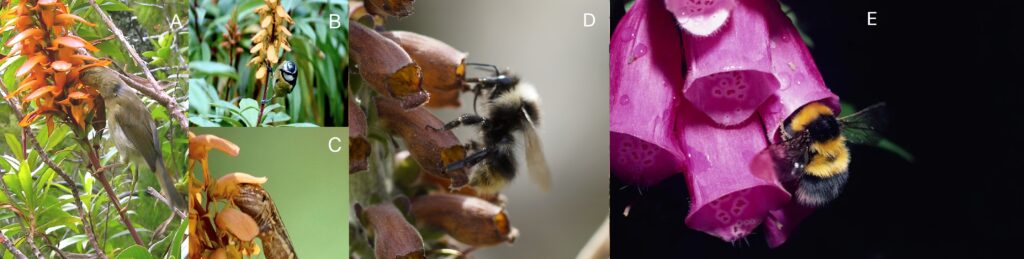
To address this question, we will combine the characterisation of floral shape, size, colour, scent and nectar with direct observations and video recordings of floral visitors in natural populations. Phylogenetic analyses will allow us to investigate how floral traits and pollinator groups have changed during the diversification of the genus, and to assess the evolutionary sequence of these changes. In addition, we will conduct reciprocal transplant experiments at the Hoya de Pedraza Botanical Garden in Sierra Nevada and the Viera y Clavijo Botanical Garden in Gran Canaria. These experiments will allow us to compare visitation rates, pollen transfer and seed production among species exposed to both pollination environments.
The project will develop and test a framework combining evolutionary reconstructions and experimental approaches to evaluate floral adaptation to pollinators. Its findings will contribute to our understanding of flowering plant diversification and provide valuable insights for the conservation of plant–animal interactions. The research will be accompanied by outreach materials produced through Divulgare, including a short film, an illustrated children’s book and a travelling exhibition.

