
What happens when scientific evidence collides with traditions, interests or collective identities?
Not all scientific papers come into being in the same way. Some begin after years of fieldwork, thousands of data points and statistical analyses. Others arise from something more uncomfortable: a persistent sense that there is an important question that almost no one seems willing to ask. The paper that has just been published belongs to this second group.
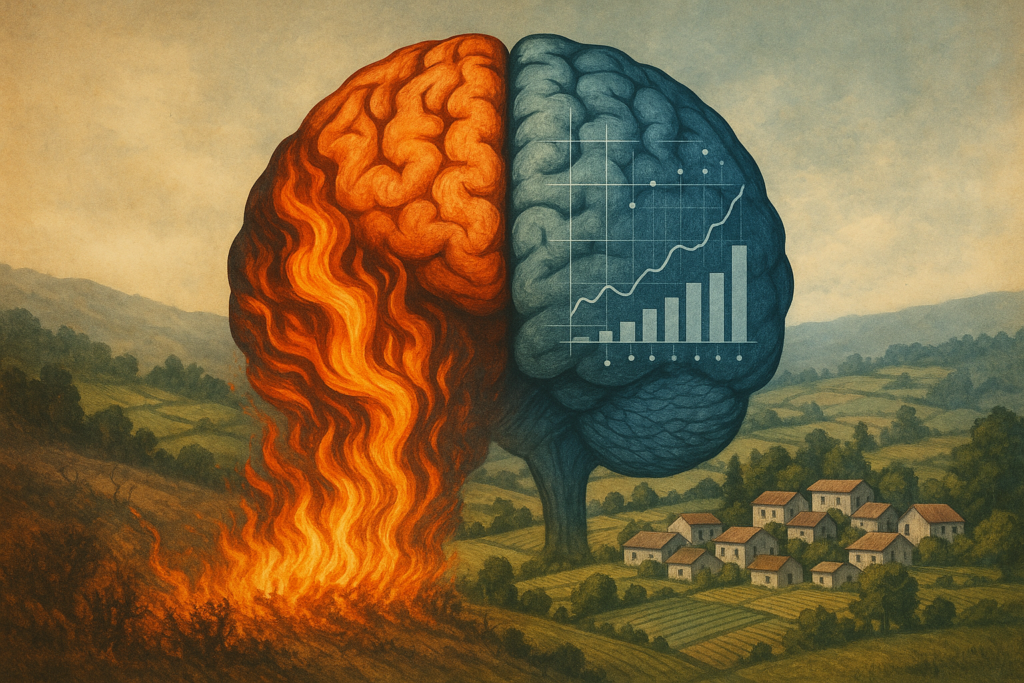
It has just been accepted for publication in Ecological Solutions and Evidence and, interestingly, it is a paper without any new data. In academia, this type of paper is usually known as a Perspective: a format in which authors do not present their own new experiments, but instead bring together existing evidence to propose an idea, highlight a problem or open up a scientific debate. Put simply, the aim is not to answer a specific question with new data, but to ask whether we may be misinterpreting something important. And in this case, the question was an uncomfortable one.
I do not work in the field of wildfires and therefore do not consider myself—by any stretch of the imagination—an expert on the subject. But… for years I have been observing a paradox that I find difficult to ignore: according to official statistics, more than 90% of the wildfires recorded in Spain are attributable to human causes, whether deliberate, negligent or accidental. Of these, a very substantial proportion is associated, directly or indirectly, with the use of fire in farming, livestock management or practices that are often presented under the banner of tradition.
Yet something curious happens when the subject enters public debate. There seems to be enormous social resistance to confronting this reality directly—as though certain facts become difficult to discuss once identities, customs or deeply rooted cultural narratives come into play.
An important clarification is needed here: the paper is not an attack on tradition, nor does it offer a simplistic defence of the opposing view. Nor does it question the usefulness of prescribed burning. Prescribed fire is, in fact, a scientific and management tool that can be extremely valuable when used properly. Applied under controlled conditions, with specific objectives, planning and monitoring, it can reduce fuel loads and help prevent large wildfires.
The problem arises when something much subtler happens. Scientific messages do not always reach society intact. Sometimes they seem to pass through a filter that retains what is useful while removing some of the nuance. A statement such as “fire can be a beneficial tool under certain conditions” may ultimately be transformed into a much simpler idea—one that is also far more convenient for some groups: “if scientists say that fire can be good, then our traditional use of fire is justified.” And that was where I decided to pause.
The question was no longer ecological; it had become almost psychological: how does scientific knowledge travel from research papers into society? What happens to it along the way? Why is some evidence accepted while other evidence meets with resistance?
The paper proposes that the main problem may not be a lack of scientific knowledge, but rather what happens when that knowledge leaves the academic context: how it is interpreted, simplified or adapted.
To try to understand this, I turned to something relatively unusual in ecology: literature on cognitive psychology and science communication. Confirmation bias, group loyalties, cultural narratives and the mechanisms that make us more likely to accept information that fits our pre-existing beliefs.
From this emerges a simple idea: if we want evidence-based environmental management, producing science is not enough. How that science is communicated also matters.
For this reason, I propose a small framework built around four pillars: improving communication of the scientific consensus; promoting the co-production of knowledge between researchers and society; using cultural frames that connect with local identities; and integrating scientific evidence more effectively into political decision-making.
Although the paper uses wildfires in the Iberian Peninsula as its case study, it is really about something much broader. Because… perhaps the problem was never only about fire.
Unfortunately, we see the same pattern in debates about invasive species, climate change, the pollinator crisis, land management and conservation. The same question arises time and again: what happens when scientific evidence collides with traditions, interests or collective identities?
I suspect that this question will become increasingly important. Because sometimes the greatest challenge is not producing knowledge. It is preventing that knowledge from being lost along the way.

