
Fifteen years later, data collected in the Caribbean help show why visiting a flower is not the same as pollinating it… and explain what my work is for.
There is a question that friends and relatives outside my professional field ask me fairly often. Sometimes they ask it out of curiosity; at other times, their expression betrays a certain puzzlement or disbelief:
– But… what is the point of what you do?
It is a legitimate question, although it does not always have a short answer. Studying how butterflies, bees and hummingbirds transfer pollen between two types of flowers on a Caribbean shrub may seem far removed from everyday concerns. Its first purpose is to help us understand how natural systems work. But it can also help us develop ways of examining and analysing much broader processes: distinguishing activity from effect, not confusing quantity with quality, and asking ourselves what it really means for something to “work”—to mention just a few of the ways in which basic research can prove useful.
The study I discuss in this post provides one possible answer. Its story also begins with data that remained written in a notebook for more than fifteen years.
Some data are born in a hurry. They are collected to answer an immediate question, analysed straight away and quickly find their place in a scientific paper. Others follow a slower path. They remain in a field notebook for years, silently accompanying us until the right intellectual moment arrives to return to them.
The data underlying this study, now published in Annals of Botany, were collected in 2006 and 2007 in Guanahacabibes National Park, at the westernmost tip of Cuba. For more than fifteen years, they lay in a kind of dormancy. Not because they had lost their interest, but because supervising doctoral theses and master’s projects, academic responsibilities and two decades of intensive dedication to science communication through Divulgare.net gradually occupied almost all the mental and physical space available.
Now, at a stage in my life when I have greater mental calm, I am returning to several of those notebooks. This is not about publishing for the sake of publishing. Each dataset must once again pass a simple but demanding test: does it still contain an idea capable of contributing something to knowledge? When the answer is yes, the work of organising, analysing, interpreting and discussing the data begins. So too does the pleasure of becoming reacquainted with the researcher one once was, and of continuing a conversation postponed for years…
A plant with two types of flowers
The protagonist is Morinda royoc, a shrub in the Rubiaceae family found in coastal environments throughout the Caribbean. Its flowers exhibit distyly, a form of heterostyly. Put simply, two types—or morphs—of flowers coexist within the same population. In one morph, the stigma is positioned high and the anthers low; in the other, the arrangement is reversed. The positions of the sexual organs are approximately reciprocal.
This floral architecture favours the deposition of pollen picked up by an animal from the anthers of one morph onto the stigma of the other. This is what we call disassortative, or intermorph, pollen transfer. In many heterostylous species, this exchange promotes legitimate mating and prevents much of the pollen from ending up somewhere it is unlikely to be useful.
The question may sound specialised, but it is actually quite intuitive: if the flowers are visited by animals as different as butterflies, bees and hummingbirds, do they all transfer pollen with the same effectiveness and precision?
A visit is not the same as pollination
During 1,770 minutes of observation, I recorded 592 visits by 13 species of floral visitors. Counting visits, however, only describes activity. It does not tell us what happens as a consequence of each visit.
To find out, some flowers were protected until they opened. Immediately after a flower received a single visit, its pistil was collected and the pollen deposited on the stigma was examined. Because the two floral morphs produced pollen grains of different sizes, it was possible to determine whether the pollen came from the same type of flower or from flowers of the reciprocal morph.
This allowed me to separate two components that are often conflated. The first is quantitative: how much pollen a species delivers, taking into account how frequently it visits and how much pollen it deposits during each visit. The second is qualitative: what proportion of that pollen comes from the reciprocal morph and therefore travels in the direction that favours legitimate mating.
A landscape of effectiveness
Plotting these two components together produces a landscape of effectiveness1. Each point represents a visitor species. The farther to the right it lies, the greater its quantitative contribution. The higher it lies, the more precise its intermorph pollen transfer. The curved lines connect different combinations that produce the same overall effectiveness.
The figure reveals something that a simple list of visitors never could. Several butterfly species transferred a very high proportion of reciprocal pollen; in other words, their pollen transfer was highly precise. Overall effectiveness, however, was concentrated in a subset of species. The world’s smallest hummingbird, Mellisuga helenae, and the carpenter bee Xylocopa cubaecola stood out because they combined substantial pollen delivery with a high proportion of reciprocal pollen transfer. The butterflies Ascia monuste and Papilio andraemon also occupied prominent positions, although they deposited less pollen per visit.
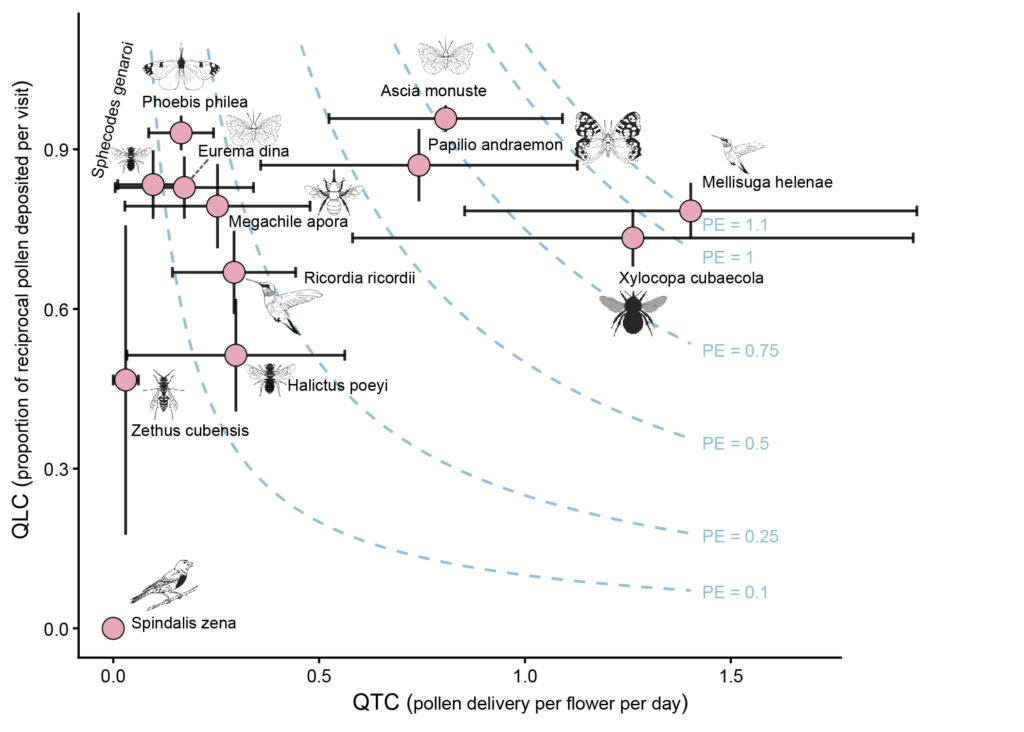
The case of Xylocopa cubaecola is particularly illustrative. Carpenter bees can act as nectar robbers in tubular flowers, and this species does so on other plants in the same island environment. On Morinda royoc, however, it behaved as a highly effective pollinator. The function of a visitor does not lie solely in its identity: it also depends on the architecture of the flower and the particular way in which flower and visitor interact.
Generalisation without a complete loss of precision
The most interesting result is not that all visitors were equivalent—they were not—but that taxonomically and functionally very different animals deposited predominantly pollen from the reciprocal morph. Quantitative effectiveness was unevenly distributed, but the direction of pollen flow remained remarkably consistent.
This suggests that the reciprocal positioning of anthers and stigmas acts as a kind of mechanical filter. The plant can be visited by butterflies, bees and hummingbirds without this diversity of visitors necessarily resulting in chaotic pollen exchange. Floral architecture gives the system a degree of robustness. Precision is nevertheless important here: the study measured pollen transfer, not fertilisation or final seed production, and it did not experimentally test the system’s response to the loss of pollinators.
From flowers to other environmental problems
The value of a study such as this is not limited to explaining the reproductive biology of a Caribbean shrub. It also helps us develop a way of analysing ecological processes: not confusing the frequency of an event with its effect, or quantity with quality.
In discussions of wildfires, for example, the number of fires and the area burned are important quantitative dimensions, but they are not enough. Two fires affecting the same area can differ radically in severity, recurrence, the types of ecosystems affected, soil loss, capacity for regeneration and social consequences. It would make no sense to transfer the pollination equation literally to fire, but it would make sense to construct landscapes that integrate magnitude with ecological consequences. Counting hectares is not enough to understand the damage.
Something similar applies to monocultures. The area occupied or immediate productivity tells us how much is produced, but not necessarily anything about the ecological quality of the system: its functional diversity, soil conservation, water regulation, dependence on external inputs, stability in the face of disturbance or capacity to sustain biological interactions. An assessment based on a single figure can render crucial processes invisible, as I have tried to explain in another post.
The methodological lesson is modest but powerful. Before claiming that an agent, a practice or an ecosystem “works”, we need to ask how much it contributes, the quality of that contribution and what the biologically relevant outcome actually is. Sometimes, behind an apparently narrow question about flowers and pollen, we are testing a much more general way of looking at the world.
The timescale of data
Returning to Guanahacabibes through these observations has also meant recovering part of my own scientific history. The notebooks did not contain only numbers: they held memories of working days in the Caribbean, marked plants, bagged flowers and animals that approached for a few seconds, unaware that their visit would eventually become part of a scientific question.
Data do not necessarily age at the same pace as our schedules. Sometimes they wait. And perhaps one of the privileges of professional maturity is being able to return to them without urgency, examine them using new tools and freely decide which of them deserve to emerge from that state of latency.
These data have now emerged. And after more than fifteen years, they have finally found their landscape.
- [I use the term “effectiveness landscape” here in a sense adapted from the framework proposed by Schupp et al. (2017): the qualitative component measures the precision of intermorph pollen transfer, rather than fertilisation, seed production or plant fitness directly.] ↩︎

