
Harry, the protagonist of The Snows of Kilimanjaro, had stories he never got around to writing. For fifteen years, this one came close to becoming one of them. Fortunately, I managed to rescue it from that field notebook just in time…
Some data take a long time to find their way from a field notebook into a scientific paper. These took no less than fifteen years.
In 2011, I took advantage of a trip to Tanzania to fulfil one of those dreams I had been holding on to for years: climbing Kilimanjaro and experiencing first-hand the extraordinary transition from Afromontane vegetation to the Afroalpine ecosystems of its highest elevations. I also wanted to see with my own eyes the extraordinarily rapid retreat of the glaciers and ice fields behind those mythical “Snows of Kilimanjaro” that Hemingway made part of our collective imagination.
Curiously enough, one of the themes running through Hemingway’s story is precisely that of experiences lived and stories left for some future day, until there is a risk that they may never be written at all. These data came close. They lay dormant in a field notebook for fifteen years. Fortunately, this little African story has finally been told.

But there was something else that fascinated me at that point in my scientific career. I had been working on plant–animal interactions for years, and I wanted to begin understanding how they worked in Africa. Because, at least from our small corner of the world, the African wildlife that reached us back then was almost invariably dominated by large animals. Lions, elephants, buffaloes, rhinos, leopards… the famous Big Five. We knew—and saw—far less about the countless interactions quietly taking place between plants and animals.
So, besides watching the Big Five (of course I did!), I spent some of my time watching flowers.
And those observations, recorded in my field notebook near Arusha in June 2011, have now resulted in this paper on Aloe secundiflora.
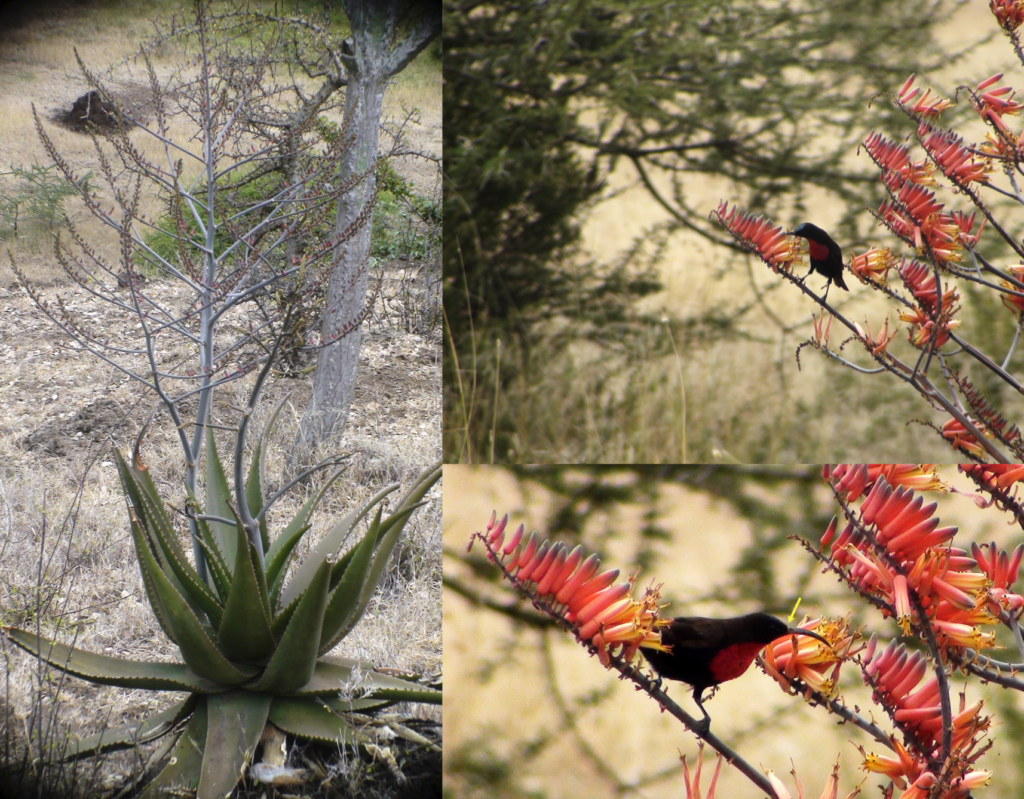
What we found tells a rather lovely little ecological story. The flowers of this aloe are visited by sunbirds, African birds specialised in feeding on nectar. Chalcomitra senegalensis, with its relatively long bill, inserts it through the flower opening and acts as a “legitimate” visitor(*), transferring pollen between flowers. Hedydipna collaris, however, has a considerably shorter bill and solves the problem differently: it pierces the base of the corolla and robs the nectar without going through the route the plant, so to speak, “expected” it to take.
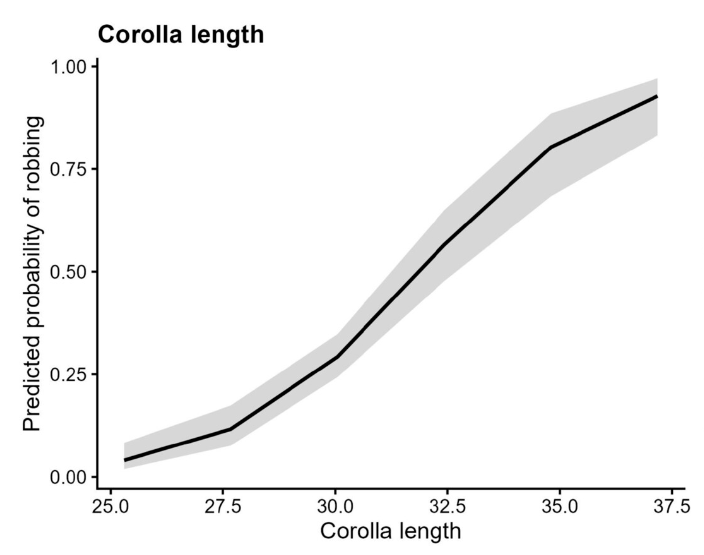
And this is where things became interesting. The longer the corolla, the greater the probability that a flower would be robbed. Approximately 34% of the 385 flowers examined showed signs of nectar robbing. Moreover, robbing did not appear to come without a cost to the plant: robbed flowers had about five times lower relative odds of initiating a fruit than flowers that had not been robbed.
It is a small study, born from barely two days of fieldwork, and perhaps that is precisely why I am particularly pleased to have rescued it from that notebook fifteen years later. It does not attempt to explain how plant–animal interactions work in Africa. It simply adds one small piece to an enormous puzzle about which we still know far less than we should.
Africa has its Big Five, and they are certainly worth seeing. But all around them, millions of far more discreet ecological stories are unfolding: flowers that create barriers, animals that find ways around them, plants that pay the consequences, and relationships that can ultimately influence reproduction and, over time, the evolution of those involved.
Perhaps we simply need to learn to look a little more slowly.
Fifteen years later, this is my small contribution to encouraging us, while we watch the big ones, to pay attention to everything else happening around them.
Harry, the protagonist of The Snows of Kilimanjaro, had stories he never got around to writing. For fifteen years, this one came close to becoming one of them. Fortunately, I managed to rescue it from that field notebook just in time…
Navarro, L. (2026). When bigger is not better: Corolla length increases nectar robbing in Aloe secundiflora. African Journal of Ecology, e70225. https://doi.org/10.1111/aje.70225
(*) “Legitimate visitor” is a term commonly used in pollination ecology. But whether a visit is legitimate or not, as my friend J. M. Gómez “Rocka” rightly says, is our concern; for the animals, they are simply different ways of accessing nectar.

